How to Invest in Polish Equity?
Practical Guide for Foreign Investors willing to start investing in Polish stocks
Economic Context
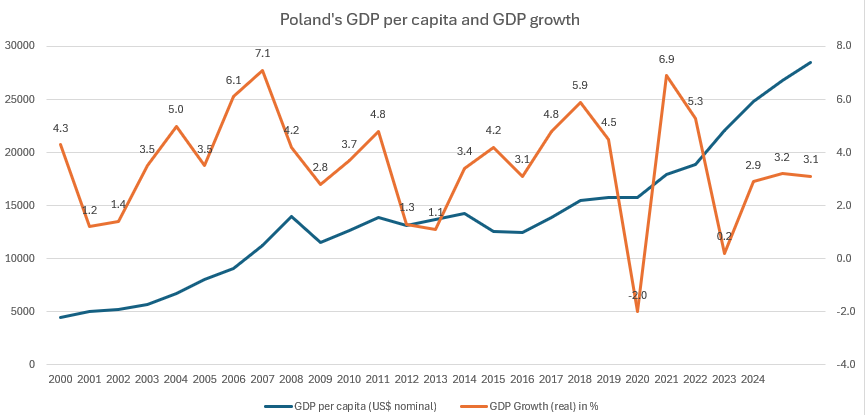
Poland’s economy is sixth largest in Europe and 20th largest in world per GDP, with a 2025 GDP around $980 billion (nominal). The country has 37.5 million citizens and is a member of both NATO, European Union and Schengen zone. Poland’s economic growth has remained resilient. Real GDP is forecasted to grow around 3% in 2025. This solid economic base, combined with EU membership, provides a supportive backdrop for the Polish stock market
Since the fall of communism in 1989, Poland has transformed from a centrally planned system into one of Europe’s fastest-growing economies. In the early 1990s, “shock-therapy” reforms briefly contracted GDP by roughly 10% in 1990 and 1991, but by the mid-1990s growth had rebounded into the 6–7% range as privatization and market liberalization took hold. Over the period 1989–2018, real GDP expanded by an astonishing 827%, the strongest performance in Europe, fueled by rising productivity, foreign investment, and EU accession in 2004. In the 2010s Poland averaged around 4% annual growth, even avoiding recession in 2009, and most recently recorded 6.9% growth in 2021 and 5.6% in 2022

Polish citizens today can complete most everyday transactions, from filing income tax returns via e-Urząd Skarbowy, accessing health records on pacjent.gov.pl or through the mObywatel app, to managing social-security benefits on PUE ZUS or registering a business in CEIDG, entirely online, without ever setting foot in an office. In the 2024 eGovernment Benchmark, Poland scored 69 points (up 7 points year-on-year), outperforming the EU27 average in User Support (100 vs 94) and e-Documents (92 vs 83). While still trailing digital leaders such as Estonia (97 points) and Malta (92 points), Poland’s rapid improvement places it among the most efficient government-service providers in Central Europe. (Source: Kluczowe wnioski z raportu eGovernment Benchmark 2024 - Ministerstwo Cyfryzacji - Portal Gov.pl)
On September 29, 2017, index provider FTSE Russell announced the results of its annual market classification review, upgrading Poland from Emerging Market to Developed Market status.
Polish Currency
The Polish złoty (PLN) is a floating currency whose value is shaped by domestic monetary policy, particularly National Bank of Poland interest‐rate decisions aimed at controlling inflation, as well as broader economic indicators like GDP growth, fiscal deficits and foreign direct investment. External factors such as global risk sentiment, euro‐zone dynamics, commodity prices and the strength of major currencies (notably the euro and U.S. dollar) also drive daily fluctuations in the złoty’s exchange rate. Consequently, while Polish equities can offer attractive returns, investors in PLN‐denominated assets face additional currency risk: even if stock prices rise in local terms, adverse moves in the złoty against their home currency can erode overall gains
Intro to Warsaw Stock Exchange (WSE)
As of July 2026, there are 403 companies, including 19 foreign ones, quoted on Warsaw Stock Exchange (in polish: GPW - Giełda Papierów Wartościowych) whose market capitalization amounts to PLN 2.86 trillion (USD 752.58 billion) making it the largest stock exchange in Central and Eastern Europe. The most important stock market indices of the Warsaw Stock Exchange are WIG, WIG20, mWIG40 and sWIG80. Trading at Warsaw runs from 08:30 to 17:00 with closing auction from 17:00-17:05
In 2020, the Warsaw Stock Exchange reached a notable milestone in the gaming sector by surpassing the Tokyo Stock Exchange in the number of listed gaming companies, establishing itself as a global leader in the gaming stock market. CD Projekt, producer of famous Witcher, Cyber Punk games, is listed on WSE.
Markets:
- WSE main market - fully regulated market under both Polish and EU law.
- NewConnect - a multilaterally traded facility designed for smaller, high‐growth companies. It offers lower entry barriers such as reduced minimum capital, fewer required shareholders, and simplified disclosure at the cost of greater volatility and lower liquidity. There are 360 companies traded on NewConnect.
- Catalyst – Polish corporate bonds market
WIG20 Index Composition and State Role
Poland’s flagship index is the WIG20, a cap-weighted index of the 20 largest and most liquid companies on the Warsaw Stock Exchange. It includes a mix of sectors such as banking, energy, mining, consumer, and tech.
Notably, state-controlled enterprises dominate the WIG20’s weighting. As of 2025, seven companies in the index are majority or significantly state-owned together accounting for about 54% of the WIG20’s total market capitalization. This means government-influenced firms (often in energy and finance) drive over half the index’s value. For example, the State Treasury holds major stakes in Orlen (oil & gas), PKO BP (banking), PZU (insurance), and PGE (electric utility), which gives the government a strong presence in the market. While private companies like Dino (retail supermarkets), LPP (apparel manufacturer), or CD Projekt (gaming) are also key players, the “state-owned quartet” of Orlen, PKO BP, PZU, and Pekao are among the top five weighted stocks
Pro tip: Avoid investing in state-owned companies listed on the Warsaw Stock Exchange, as they are often treated as instruments of government policy rather than profit-driven businesses. The state may drain their earnings through mechanisms such as sponsoring politically motivated events, financing public programs, overpaying for government contracts or maintaining uneconomical operations for political gain. For the same reason avoid buying ETFs which follow WIG20.
State owned companies in WIG20 are:
| Name | Ticker | Industry |
|---|---|---|
| Alior | ALR | Banking |
| KGHM | KGH | Mining |
| PEKAO | PEO | Banking |
| PGE | PGE | Utilities |
| PKN ORLEN | PKN | Oil & gas |
| PKOBP | PKO | Banking |
| PZU | PZU | Insurance |
Other indexes and markets
- WIG - The WIG Index (Warszawski Indeks Giełdowy) is the primary and oldest stock market index of WSE, introduced on April 16, 1991, with a base value of 1,000 points (as of June 2025 its above 100 000 points). It serves as a comprehensive barometer of the Polish equity market's overall performance. The four biggest constituents are state-owned companies (PKOBP, PKN ORLEN, PZU, PEKAO).
- mWIG40 - comprises 40 medium-sized companies listed on the WSE Main Market. 20% of mWIG40 market capitalization is accounted for financial sector (Millenium, ING, Handlowy).
- sWIG80 - comprises 80 small-sized companies
- NewConnect - offers lower entry barriers such as reduced minimum share capital of only PLN 100 000, 10 required shareholders, and simplified disclosure at the cost of greater volatility and lower liquidity. NewConnect lists hundreds of smaller firms, predominantly in technology and life sciences, with significantly lower aggregate market value. Companies follow simplified disclosure rules, typically submitting annual reports and less frequent interim updates.
Market Participants: Institutional vs Individual Investors
The Polish stock market’s activity is driven largely by institutions, especially foreign investors. In 2024, foreign investors accounted for 68% of trading volume on the main market. In 2025 their share reached 70%. It was the highest share in over a decade. By contrast, domestic institutional investors made up about 17% of turnover, and domestic retail (individual) investors just 13%. The pie chart above illustrates this breakdown. Foreign institutions (like global funds, pension funds, and banks) have long played a key role in Warsaw, providing liquidity and capital.
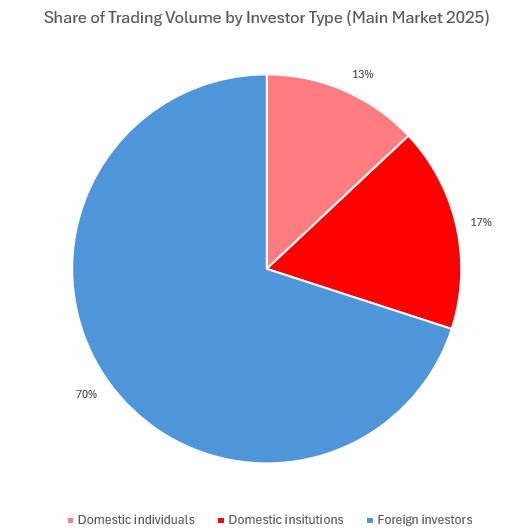
Domestic individual investors, while growing in number (a record 2.857 million brokerage accounts exist), still represent a small fraction of trading (13% in 2025). However, the retail share has been declining slightly in recent years (down from ~16% in 2023) as foreigners increased their activity.
In terms of ownership, a similar picture emerges: foreign investors are estimated to own roughly half of the free float of Polish listed companies (and an even higher proportion for blue-chip stocks). Domestic pension funds and mutual funds hold a significant chunk as well (especially after pension reforms, domestic institutions became important stable shareholders). Retail investors own a smaller portion of market capitalization, but their influence is larger in smaller-cap stocks and the NewConnect market (where individuals still contribute ~84% of volume
Market inefficiencies
The Warsaw Stock Exchange (WSE) often exhibits characteristics of an inefficient market, where prices do not immediately reflect all available information. As a result, material news such as contract announcements, or regulatory changes can take hours or even days to be fully priced into a stock. This delayed market reaction creates potential opportunities for informed individual investors who can quickly interpret and act on new information before it is broadly reflected in share prices. In inefficient market the passive management is not desirable because “you can beat the market” as the market not always reflects the available information.
How to invest?
Investing is risky. Invest responsibly.
Brokers
There are multiple brokers offering access to Polish stock market. Below are couple guidelines related to choosing the right one.
Carefully review the broker’s fee structure, including trading commissions, account maintenance charges, and any fees related to deposits or withdrawals. Compare minimum deposit requirements, available leverage, and the range of account types offered. Additional features such as access to educational materials, market research, and responsive customer support can further enhance your trading experience, particularly for less experienced investors.
Example of brokers offering access to the Warsaw Stock Exchange
XTB (https://www.xtb.com )
Trading is risky. Invest responsibly
)
Trading is risky. Invest responsibly
- A Warsaw-based broker known primarily for CFDs and forex, XTB also provides probably the broadest availability of stocks trading on the WSE including microcaps from NewConnect. It is virtually commission-free for WSE stocks, for investments in equities and ETF up to 100'000 euro a month. I use it personally for investing in Polish stocks. It offers a user-friendly platform (xStation), real-time market data, and competitive commission rates, probably that is why it is most popular stock broker in Poland with over 1 mln accounts as of June 2026 You can open XTB account directly via this link
- A U.S.-founded global brokerage with access to over 135 markets including the Warsaw Stock Exchange. IBKR is prized for its low execution costs, deep liquidity, and advanced order types. Its Trader Workstation (TWS) platform offers professional-grade charting, API connectivity, and multi-currency accounts, appealing to active and institutional investors.
ETFs
I wrote ETF guide for Polish investors here.
Tax implication of investing in Poland
Investors who are not Polish citizens
A non-resident individual is subject to Polish Personal Income Tax (PIT) only on Polish-source income (limited tax liability). For portfolio investors this covers:- Dividends distributed by a Polish company;
- Capital gains realised on the sale of shares or other WSE-listed instruments, but only when Polish domestic law or an applicable double-tax treaty (DTT) gives Poland taxing rights. Double-tax treaty agreements take precedence over Polish Personal Income Tax.
- Standard rate. Polish companies must withhold 19 % from dividends paid to non-resident individuals.
- Treaty relief. Most double-tax treaties reduce the rate to 15 % (e.g., Switzerland, France, the U.S.) or 10 % (e.g., Germany, Spain). The reduced rate applies at source when the shareholder submits:
- a certificate of tax residence (valid for the payment year); and
- a beneficial-owner declaration (standard brokerage form).
- Refund option. If no documents are lodged in time, the shareholder may apply for a refund to the Head of Warsaw-Śródmieście Tax Office; the statutory deadline is five years from year-end.
- Domestic rule. Gains realised by individuals on the transfer of Polish securities are taxed at a flat 19 % PIT rate (Art. 30b PIT Act). Polish brokers normally calculate, withhold and report them on information form PIT-8C.
- Double-tax treaties. In most of Poland’s 90 + treaties, the OECD-model wording of Art. 13 allocates taxing rights on listed shares exclusively to the investor’s state of residence (unless the investor owns a substantial usually > 25 % stake). In such cases Poland must refrain from taxation, so any 19 % tax withheld by a Polish intermediary can be reclaimed.
Polish citizens who now live and pay tax abroad
Polish nationals who have moved their tax residence abroad (centre of vital interests outside Poland or > 183 days abroad) are treated identically to other non-residents for Polish tax purposes (Art. 3 § 2b PIT Act). If you have moved your tax home abroad (you spend most of the year there and your “centre of life” is there), Poland treats you like any other foreign investor.
The main difference is that if your Polish broker submitted PIT-8C to Polish Tax Office, it will trigger generation of PIT-38. In such a situation you should modify automatically generated PIT-38 and declare zero revenue on grounds of double-tax treaty relief. In case tax was paid or withheld there is step-by-step refund process (capital gains or dividends): 1. Obtain an original residence certificate (and sworn Polish translation if the language is not English/German). 2. File annual PIT-38 by 30 April declaring Polish-source revenue as zero or treaty-exempt (fields 1b, 2b and 3b in tax declaration form should be zero). 3. Submit a “Wniosek o stwierdzenie nadpłaty” (application for confirmation and refund of overpayment) to the competent tax office, attaching the certificate, PIT-8C, proof of tax payment and bank account details. 4. Expect the refund within 30 days of the decision becoming final; interest is added if the office exceeds statutory deadlines.
Tools
Our platform allows you to familiarize with selected group of interesting investment opportunities in Poland (don't treat those companies in WSE Screener as financial advice). You can obtain understanding of the company’s business model, financials, and key risks. You can also read transcripts of earnings calls. For selected group you can deep dive thanks comprenensive, bespoke analysis. The platform is designed to help you make informed investment decisions in the Polish equity market.
Other tools for market analysis:- Stooq (https://stooq.pl/) A free financial data portal offering end-of-day and intraday charts, historical price series, and customizable technical indicators for WSE stocks. It includes simple screeners and the ability to overlay indices, commodities, and forex for cross-market comparison.
- Scrab (https://scrab.com/) Scrab lets you filter companies by metrics such as P/E, dividend yield, or market cap. It helps investors quickly narrow down lists based on both fundamental and technical criteria, with regularly updated financial statements.
- BiznesRadar (https://www.biznesradar.pl/) A comprehensive research site providing real-time quotes, corporate news, earnings calendars, and detailed fundamental data on WSE–listed firms. BiznesRadar offers customizable watchlists, analyst consensus forecasts, and interactive charts to support in-depth stock analysis.
- Puls Biznesu (https://www.pb.pl) A leading Polish business daily that serves as a valuable source of information for investors, analysts, and financial professionals. It provides up-to-date news, in-depth company reports, market commentary, and insights into the Polish economy, capital markets, and specific sectors. The publication is particularly useful for tracking developments on the Warsaw Stock Exchange, regulatory changes, and corporate actions. Its online platform also offers access to databases, interviews, and rankings, making it a reliable tool for conducting both qualitative and quantitative financial analysis.